Battle Flag vs. "Rebel Flag"
The most revered and most recognizable symbol of the South is the Battle Flag of the Army of Northern Virginia. It is a square flag featuring a blue St. Andrew's Cross holding 13 white stars upon a red background, surrounded by a white border. The "Rebel Flag" is a rectangular flag with an elongated St. Andrew's Cross holding 13 white stars upon a red background without a white border. The two flags are similar, but when viewed side by side can been seen to be quite different.
The "Rebel Flag" was the Battle Flag for the Army of Tennessee and used as a naval ensign. In more recent times it has been used by organizations making false claims to Southern Heritage. The flag is common today because it has such a recognizable design, appeals to individualists and, as opposed to the Army of Northern Virginia Battle Flag, is easily manufactured at standard flag making companies.
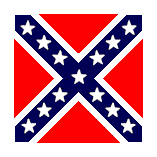 | 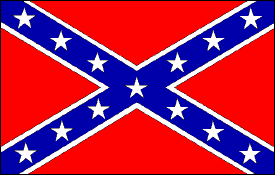 | |
| Battle Flag | "Rebel Flag" |
The ANV Battle Flag was created for use by infantry units and was incorporated into the 2nd National and 3rd National flags of the Confederacy. It was also incorporated into the state flags of Mississippi and Georgia.
Square flags are unusual in contemporary times, but were fairly common for military uses in the 19th century and still are found to a lesser degree today. The flag's most prominent feature is the blue St. Andrew's Cross. This feature symbolizes the ancestry of the original colonists to the South. As opposed to the New England colonists who came to escape religious persecution, the colonists who settled in the South came to cultivate the land and build an agrarian society. The St. Andrew's Cross symbolizes those ideals.
The 13 white stars represent the 13 states that comprised the Confederate States of America from 1861-1865. There is some debate about whether the number should be 11, 12 or 13 states and there are historical versions of the flag with only 12 stars. The debate comes from whether Missouri and Kentucky were part of the Confederacy. Both states had, at the time of the war, two state governments: one pro-Confederacy and the other pro-Union. Whatever the outcome of that debate, the Battle Flag represents them along with the other 11 states of: Virginia, North Carolina, South Carolina, Georgia, Florida, Alabama, Arkansas, Louisiana, Mississippi, Texas and Tennessee.
The flag was created to help distinguish the Confederate units from their Union counterparts during battle. The 1st National flag of the Confederacy, otherwise known as the Stars and Bars, was easily mistaken for a U.S. flag from a distance. Add to that, units in the early stages of the war wore a hodgepodge of uniforms - some Northern units wearing gray and some Southern units wearing blue. In order for the troops to know who was friend and who was foe, a more distinctive symbol was required and that is what led to the creation of the Battle Flag.
With most units having their own version of the Battle Flag, it became a symbol both North and South of the Confederacy. It is for that reason, when a new national flag was designed, the Battle Flag became part of the new 2nd National Flag.
Bonnie Blue Flag
 "Hoorah, hoorah, for Southern Rights hoorah. Hoorah for the Bonnie Blue Flag that bears a single star." So go the lyrics to the popular Southern song "Bonnie Blue Flag". Although never an official flag of the Confederacy, it was a temporary national symbol from the infancy of what was to become the Confederate States of America. The single star is a symbol of unity and it is to this day a symbol of Southern Heritage and the spirit of Southern Unity. The flag itself is also known as the "Commodore Flag" and is used nautically.
1st National Flag (Stars and Bars)
 A new nation needed a national flag and so came the 1st National Flag, commonly known as the "Stars and Bars". Before the old and powerful states of the South joined the Confederacy after the Lincoln's call for volunteers to fight the Confederacy, the 7 states that formed the Confederacy designed the Stars and Bars. That is the reason there are only seven stars in the canton of the true Stars and Bars.
As mentioned earlier, the Stars and Bars was much too similar in appearance to the U.S. flag. In the smoke-filled confusion of battle, the flag was not distinctive and the 'follow the flag' tactics of the early stage of the war were severely hampered by having a flag that was hard to distinguish.
Although replaced by the 2nd National flag, the Stars and Bars did not disappear. Individual units still used the flag, some adding stars as more states joined the Confederacy. The headquarters flag of Robert E. Lee is a modified version of the Stars and Bars.
2nd National Flag (Stainless Banner)
 In many ways, the 2nd National Flag or "Stainless Banner" as it is lovingly called, is the most loved of the official flags of the Confederacy. It was created to be distinctive and eliminate the confusion caused by the Stars and Bars. It incorporates the Southern Cross from the Battle Flag in the canton of a pure white flag. The startling contrast of the red against the simplicity of the rest of the flag gives it the quality that brought the name "Stainless Banner".
Despite the aesthetic beauty of the Stainless Banner, it was also found to be problematic in the confusion of battle. In conditions where no wind lifted it or when it became wrapped around its pole, it resembled a flag of surrender. With the rules of war at stake (forbidding false surrenders), the Confederacy had to change its flag in order to make it clear when troops were and when they were not surrendering. So, ended the period of the beloved "Stainless Banner".
3rd National Flag
 A striking flag, the 3rd National is the Stainless Banner plus a broad red vertical bar at the far end. This made the flag very distinctive and removed confusion about the disposition of the units, even in light winds or when the flag became entangled. Through the darkest days of the war, the 3rd National served as the last of the Southern flags. It remains today as the official symbol of the Confederacy from a historical perspective and a very popular flag due to its recognizable St. Andrew's Cross and striking contrasts in color and shape.
The Official Salute to the Confederate Flag is as follows:
I salute the Confederate Flag,
with reverence,
affection,
and undying devotion
to the Cause for which it stands.